Pages

Saturday, 16 August 2008

Mother Russia is waiting...

A Jager anxious to poke some holes into some convenient Frenchman.

Recently I've been working steadily on my French army; but the Russians, while on the back-burner, have certainly not been forgotten.

As with Jean Crapaud and his chums, I have decided to go the two-rank deep basing method as per General de Brigade rules. As many of my Russians are in advancing pose with levelled musket (see photo above), this means I have been cleaning the flash from some figures advancing at the port arms position that will make up the second rank.

The new basing system can be seen
here. There will be about seven figures to a company, each stand having a 60mm frontage and a depth of 50mm. This is a little deeper than my French battalions which are 45mm deep. The Front Rank Russians are a little "bulkier" and need the extra space. Doesn't make any difference to game play- the depths are grossly out of scale as it is!

Note that the elite company will be split into two platoons, with the tirailleur platoon on the left, and the grenadier platoon (carabinier for jagers) platoon on the right flank of the regiment. This rather nicely places the flags in the centre of the unit when in line.

Once I finished the targets I set myself for August, the next step will include Russian infantry- a battalion of line and one of jagers most likely.


Sunday, 1 June 2008

Progress. Slow, but Progress...

Officer of 38th Jagers in very much campaign wear! One of a number of Foundry minis in an otherwise Front Rank collection. He's not as "bug eyed" in real life as he seems to be in this shot!

Progress of sorts, anyway. I have been steadily daubing paint on my Russians (and French!) these last few weeks, namely because I have learned how much easier it is to start with a black undercoat! I have always used white or grey in the past, but I am finding that black actually suits my painting style better, and I was actually rather pleased with the results I have been getting. I did need stronger lighting over the painting table, though.

My collection is not all Front Rank miniatures; I broke down some time ago and ordered some of their Russian command figures for variety, this despite their almost piratical postage rates to the Far East (and which compared badly with just about every other manufacturer out there- grrr...).

Now these are Perry-designed miniatures, so nice design and detail throughout. They are larger than The Foundry's range of French, and while the Front Rank figures are a mite taller, these are certainly compatible even when mixed in the same unit.

The biggest disappointment was the casting quality, or lack thereof. The moulds have been allowed to deteriorate far more than should be acceptable, especially given the premium rates that The Foundry charges. This manifested itself in drums and scabbards, etc. that had not come out completely and which required some major work with epoxy putty to repair.

I very much doubt I'll be troubling with further orders from these guys.

Now having said that, I am happy with the extra variety they lend my Russian army, notably the officers, and especially the greatcoated drummers and standard bearers, something Front Rank never covered. What between them and the conversions I have been carrying out on a few of the Front Rank minis, I can add something "different" to each battalion.

Picture taken with my new 5-megapixel cellphone digital camera. Green and blue remain difficult colours to get right, though. I need to experiment more with the settings and lighting.

Monday, 25 February 2008

A new look & some improvements

Russian Drum Major-(after Viskovatov)


It has been an age since I last posted, but I have been distracted by other projects. It seems I really do have the attention span of a moth suffering from Alzheimer's.

Anyway, I have been tuning up my blog, now that I have learned how to produce decent headers and to link music files.  The result can be seen here.

Musically speaking, Here are three marches now using MP3 format so you should be able to just press the button and have the martial splendours of St. Petersburg waft through your speakers.

"The Fall of Paris" was actually a parody of the French Revolutionary song, "Ca Ira".

This one is from the movie "Gettysburg", but it was originally written to celebrate the victory of the Allies as they overthrew Napoleon's regime in 1814.

The famous
Preobrazhenskoi Guard Regimental March. is rather special for me, as it was also the slow march of my father's old regiment, the Royal Marines.

The
March of the Semionovskoi Guard Regiment is one of my favourites- it just has that stately cadence which I have always imagined Russian soldiers would be goose-stepping to.


Tuesday, 23 October 2007

The Kinburn Dragoon Regiment


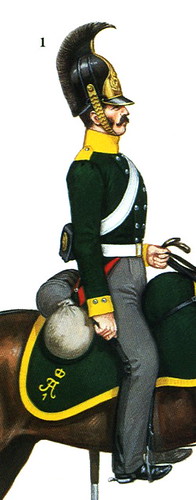
I've begun getting to work in earnest on the smaller of the three dragoon regiments of the Advanced Corps, namely the Kinburn Dragoons. To the right are are images of the flags it carried (drawn again by James D. Gray). Below right is the coloured standard (white cross in center). Above it is the first (colonel's) standard.

On the left I've added an image of a trooper of the Kinburn Dragoons as featured in one of Bryan Fosten's plates in the Osprey publication, The Russian Army of the Napoleonic Wars (2): Cavalry 1799-1814 by Philip Haythornthwaite. I have always found the Russian cavalry uniforms of the time to be quite elegant compared to the showy garb of some other nations of the time, and this illustration conveys that very well. The dark green sets off the yellow facings nicely.

I prefer a darker green for my Russians- the original green was almost black when new, and although it would fade over time, I still feel that a lot of Russian miniatures out there are painted a shade of green that end up being too light- or too bright- for my tastes. While allowing for the effect of scale colour, I go for a very dark green (although I may highlight with something lighter, especially when only a small amount of green may be showing- between straps for example).

Painting cavalry can be a pain what with the straps and trying to get a horse to- well, look like a horse! But the biggest chore is to remove flash and to actually glue the riders to the horses. It almost always takes some filing and tweaking to get a good fit between the two. I cannot stand having a big gap of space between the equine posterior and the saddlecloth!

In the case of the Kinburn, I am modifying the officer figure as I like to model some variety between the regiments. A few troopers will be wearing forage caps or bandaged heads instead of helmets for the same reason.

I will have two, six-figure squadrons of the Kinburn Dragoons. The Kharkov and Kiev Dragoons will each field four squadrons- a lot of dragoons in this army!

Saturday, 15 September 2007

Reading material for a long weekend!


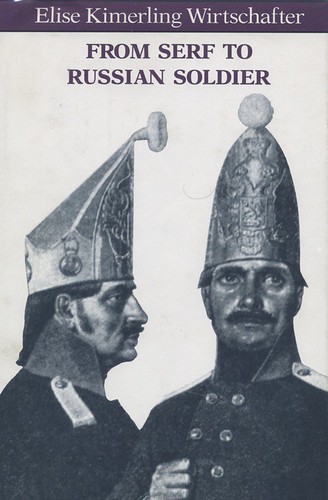
In the course of a discussion I had with "Suvoroff" (James D. Gray) about various books on the Russian Army, he mentioned one I had not in fact heard of before- "From Serf to Russian Soldier", by Elise Kimerling Wirtschafter. It is a scholarly account of the soldiers of the Russian army during the first part of the 19th Century.

Although it is out of print, I promptly did an Internet search and was able to find a copy through Amazon. I immediately ordered it from the Tacoma Book Center in Tacoma, Washington. It arrived in my postbox here in Tokyo just four days after ordering- which was pretty impressive.

I will be adding my thoughts about the book to this post once I have had the chance to read it through. So tonight, I will pour myself a glass of vodka, crank up my compilation of Russian regimental marches for some suitable BGM, settle down in the armchair and immerse myself in the Russian army!

Revised Painting Chart

One of the great things about having a blog is its ability to attract the attention of fellow enthusiasts, and the exchange of information that results.

Recently, I have had the pleasure of corresponding with Mr. James D. Gray, aka "Suvoroff". A contributor to the General de Brigade Napoleonic rules forums, he is a clearly dedicated aficionado of the Russian army. On top of that, and going from the photos he has sent me of his collection of second-generation 15mm Minifigs 1812 Russians, he is also evidently a very fine painter!

His knowledge, and his willingness to share it, have been a great help.

The results of his input can be seen in the new flags you can see in my revised painting guide. He reminded me that for those regiments that were around when the 1797 patterns were issued, they would most likely not have received the 1803 pattern until the old 1797 patterns had worn out. In many cases, this meant until the end of the wars.

James was kind enough to send me images that he had created of the 1797 pattern flags for the regiments in question, and has given me permission to post them on my blog.

So, click on the link and you can see the new "plumage" of the IXth Corps. Only the Kourinski and Iakoutski regiments, both formed after the 1797 regulations had been superseded, are to carry the 1803 pattern. The rest are to fight under the more varied 1797 issue flags.

I am very pleased with the changes, as they will make for a much more colorful force that would have been the case had they all been bearing the 1803 pattern. In particular I find the black and pink colours of the Kozlovski Regt. to be striking, and they are my personal favorites.

I would like to express my sincere gratitude to James for his generosity- many thanks, Suvoroff!

Monday, 13 August 2007

Orders of Battle

A lot of time was spent on selecting an appropriate Order of Battle. In the end I relied mainly on the orbats found in the appendices of George Nafziger’s Napoleon at Leipzig and Napoleon at Dresden. It was clear that there were a lot of changes in the composition of Langeron’s Army Corps- and in the IXth Corps itself- in the time between the beginning of the Leipzig campaign and the invasion of France- this seems particularly to have been the case with the cavalry, where divisions were split up, separated, and reunited only to be split off again according to the strategic demands of the situation.

It was also very clear that attrition took its toll over the months, and the number of men- and of battalions- decreased steadily over time. On paper, a Russian division was to consist of up to six regiments for a total of fifteen battalions of 640 men each. By Leipzig, it seems the average Russian regiment consisted of about at no more than 475 effectives.

Again, what I was looking for was an organization that would give me a good-sized wargaming force, along with a reasonable contingent of cavalry to help fend off the minions of Napoleon. In the end, I settled for the orbat provided in the Leipzig book. The number of battalions in the division at that time, and the cavalry that made up the Advanced Guard under Rudsevitch, added up to a balanced and reasonable force (read: not TOO expensive) to collect.

There were some inconsistencies in some other sources. Digby Smith’s excellent book on the Battle of Leipzig has the Kursk regiment in place of the Iakoutski regiment in the 15th Infantry Division. While certainly there were some instances of regiments and even brigades being reassigned from one division to another (for example, the 12th and 22nd Jaegers were originally from the 13th Division), the Kursk Regiment should normally have been with the 10th Division under General Osten-Sacken. As the Iakoutski regiment “reappears” in later orbats with the 15th, and the 10th Division did not appear strong enough that it could “donate” battalions to other corps, I decided to stick with Nafziger and keep the Iakoutski as an original member of the line-up for the 15th Div. Besides, I already had the flag!

Still, as the Kursk regiment does not appear in any of the orbats for the 10th Division, I would be interested to know what happened to them- burned up at Lutzen and Bautzen, perhaps?

The artillery was another area where I had conflicting information, and many batteries seem to have been attached and re-attached to units, or put into reserve, depending (understandably) on the needs of the moment. Here I settled with Nafziger and decided to field two batteries, one heavy line battery and a light battery of the Horse Artillery. Likewise, I have included the third battalion of the Riajski Regiment, which sometime between the opening of the campaign and the battle of Leipzig, seemed to have disappeared from the order of battle- most likely being disbanded to provide reinforcements for the first battalion.